
Hammond Previous Residents by Era
No record type spans every Hammond decade in the same way. Choose the source closest to the date, then use a second source to test the name and address. Deeds trace ownership. Directories and census schedules describe listed households. Maps preserve the shape and number of a place.
| Source | Hammond years found | Where held | What it adds |
|---|---|---|---|
| Recorder deeds | Office records exceed 200 years; web cutoff unknown | Lake County Recorder account, counter, request | Grantor, grantee, instrument, legal description, book/page |
| Early directories | 1889; Smith 1911-12 and later cited runs | Indiana State Library and local history room | Dated name and address listings |
| Directory microfilm and Polk | 1917-29; 1948-58; selected years to 1979-80 | State and Hammond libraries | Household, business, and street snapshots |
| Haines criss-cross | 1980, 1981, 1984, 1985, 1988 | Hammond local history holdings | Address-to-occupant lookup |
| Federal census | 1790-1950 public under the 72-year rule | National Archives access and library databases | Household at the enumeration date |
| Plats and Sanborn maps | Plats 1873-1922; Sanborn 1886, 1887, 1898, 1915 | Library collections and Library of Congress | Lot, footprint, material, use, number, and street context |
| Obituary index | Service statement 1931-2019; later annual index headings | Hammond Public Library | Death date, page, family and address leads |
For a recent transfer, start with XSoft and the recorder. For a mid-century question, use the deed date to select nearby Polk and census years. An older lot may need a plat or Sanborn sheet before a printed number can be tied to modern land.
Fix the Hammond Parcel First
Before searching previous residents, record the current situs address, owner, parcel ID, legal description, subdivision, and lot from the Lake County XSoft assessor. Keep the mailing address in a separate note. A successor owner may receive mail at another location, and that mail field must not replace the physical address.
Hammond parcel IDs retain a leading 45 plus dashes, zeroes, a decimal, and a tax-district suffix. Preserve the exact string. The legal description is even more durable because a parcel can be split, merged, or renumbered while its lot and block remain recognizable in older deeds and plats.
Trace Hammond Owners Backward
A chain of title is the sequence of recorded transfers affecting the same land. Begin with today's assessed owner, then move from each purchase to the seller. Check the legal description at every step. A same-name match on a different lot is not part of the chain.
- Save the assessor owner, parcel ID, legal description, lot, block, and transfer clues.
- Search the Lake County Recorder for the current owner as grantee and find the purchase instrument.
- Read the seller, or grantor, plus recording date, book/page or document number, and legal description.
- Search that seller as an earlier grantee. Repeat only while the land description still matches.
- When the online index stops, request the recorder book or counter search, then use plats and library sources as finding aids.
- Grantor
- The party conveying the recorded interest.
- Grantee
- The party receiving the recorded interest.
- Chain of title
- The linked sequence of instruments for the same land.
- Legal description
- The lot, block, subdivision, or boundary text identifying land even when a street address changes.
Hammond Deeds Beyond the Web
The Lake County Recorder index is account-gated. The office says its recordings are more than 200 years old and total more than three million documents, but it does not publish a verified online cutoff year. The age of the office collection must not be presented as the age of its web index.
If registration or online coverage blocks the search, use the recorder counter, direct office contact, or a focused APRA request for an existing index or copy. The Indiana State Library county guide, old plats, local directories, and microfilm can bridge names and book references. Online document purchases are listed at $1 per page plus a $3 order fee, subject to confirmation.
Reverse Hammond Addresses With Haines
Haines criss-cross volumes for 1980, 1981, 1984, 1985, and 1988 are the clearest late-century bridge from an address to a listed person or organization. Search the street, then the number. If the volume skips the year of interest, bracket it with the nearest editions and do not assume the occupant stayed through the gap.
The broader publisher and shelf history belongs on the Hammond city directories page. For address history, the key point is narrower: a directory line means the name was printed at that address in that edition. It is not a deed, a certified record, or proof of every person present.
The successful manifest image comes from the digitized September 1928 Hammond directory.
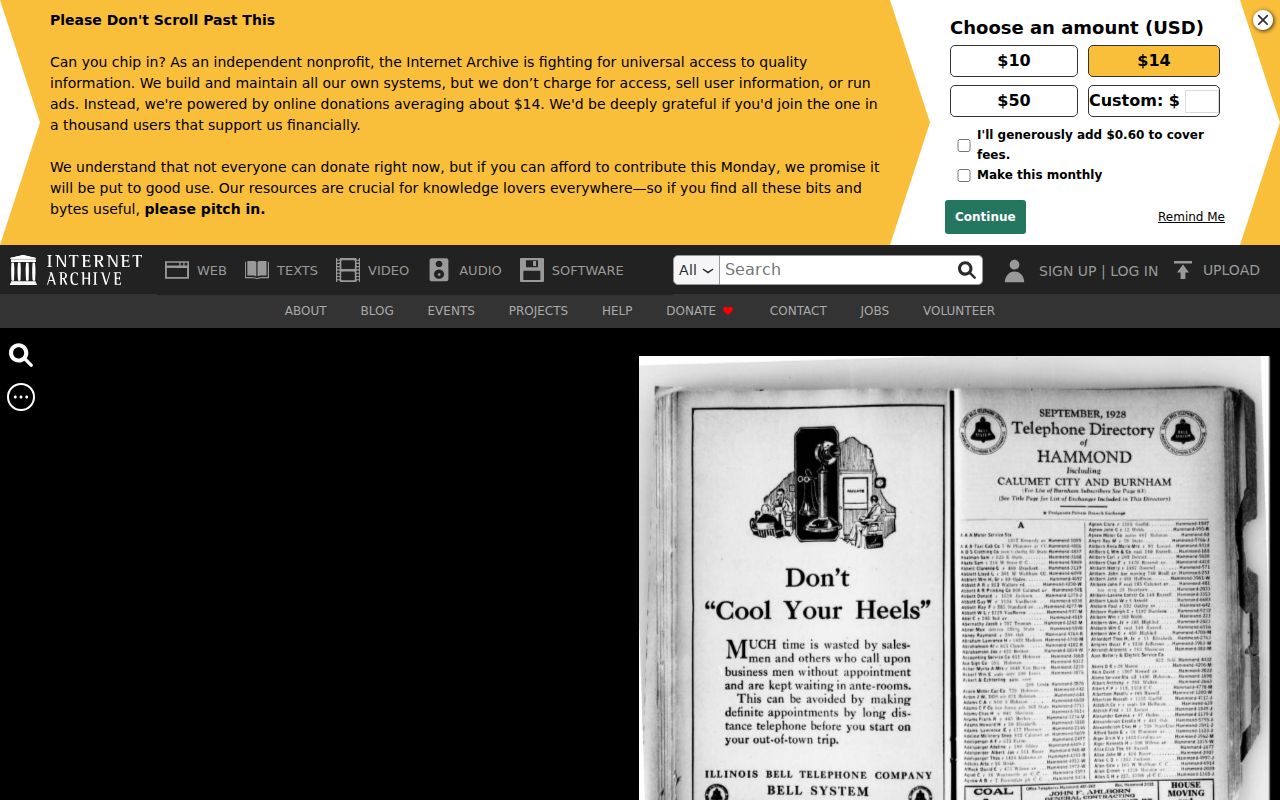
The scan makes the limits of OCR visible. Short forms such as r for residence and ofc for office can be lost or misread, so verify the page image before attaching a historical name to an address.
Date Hammond Buildings With Sanborn
Library of Congress Sanborn items cover Hammond in 1886, 1887, 1898, and 1915. The sheets show building footprints, materials, stories, uses, street widths, lot lines, and house or block numbers. They can show that a structure existed by a map date or that numbering changed. They do not identify the legal owner or every person who lived there.
Use a Sanborn sheet between the plat and directory steps. First match the block and street. Then compare the footprint and number with a directory edition near the same year. Finish with the recorded deed or tax source. The Library of Congress collection provides the online route, while the Indiana State Library explains state map access.
Bridge Hammond Numbers and Names
Hammond's 1930 street-numbering map and 1938 owner-marked house-numbering map can connect a printed number to a modern parcel. The city code sets a north and south baseline from the Lake Michigan margin and Chicago's 106th Street, plus an east and west baseline at State Line Street. It assigns 100 numbers per 660-foot block.
Street renames also break a literal search. Try 171st Street and Earl Cliff Drive for records around the 1984 change. Roselawn Street became Ben Levin Drive that year. Empress Drive and Place became Casino Center Drive in 2001, while Columbia Circle changes span 2008 to 2010. Search both names and cite the ordinance date.
Match Hammond Directories and Census
Owners are only one part of a past household. Pair the closest directory edition with a public census schedule, while accounting for the census enumeration date and the directory publication date. The 1950 census is the latest released decennial schedule under the 72-year rule. The 1960 schedule is not yet public.
- Choose the directory year closest to the deed transfer or target date and copy the entry exactly.
- Open the nearest public census year and locate the same street, household, or enumeration district.
- Compare names, ages, relationships, and address order, but allow for moves between the two dates.
- Check the next directory edition to see whether the listing persisted, changed, or vanished.
A directory can include a person missed by a deed because the person did not own the land. A census can supply the household at one official date. Neither source should be stretched into a year-by-year occupancy claim.
Hammond House History at Library
The Suzanne G. Long Local History Room does not publish a stand-alone house-history guide, but its holdings form a practical service: directories and phone books, maps and plat books, newspapers on microfilm, subject and biographical files, yearbooks, scrapbooks, and photographs. Searchers can bring a current and former street name, rough year, legal description, and parcel ID.
The Hammond Public Library local-history room lists Tuesday and Thursday 1 to 5, Wednesday 1 to 9, and Friday 9 to 1, with other visits by appointment. Staff help depends on request size and availability. Copy, scan, or email service is stated at $0.10 per page, while high-quality reproduction and permission are separate.
Close Hammond Past Resident Trails
The library's Hammond Times and Northwest Indiana Times obituary service states coverage from 1931 through 2019, while visible annual index headings continue later. Confirm the issue with staff. An obituary may identify family, a death date, or another address. It remains a lead until the cited notice is read, but it can connect previous residents to the next family or estate record.
Probate files are kept by the Lake County Clerk. Search by decedent and approximate filing year, then ask for the case number and public filings. A probate transfer can connect the estate to the next recorder instrument. Restricted, sealed, or confidential papers must not be treated as available.
Lawful use. Research previous residents for house history, genealogy, estates, or personal curiosity. Never use an old address trail to track or harass a living person.